
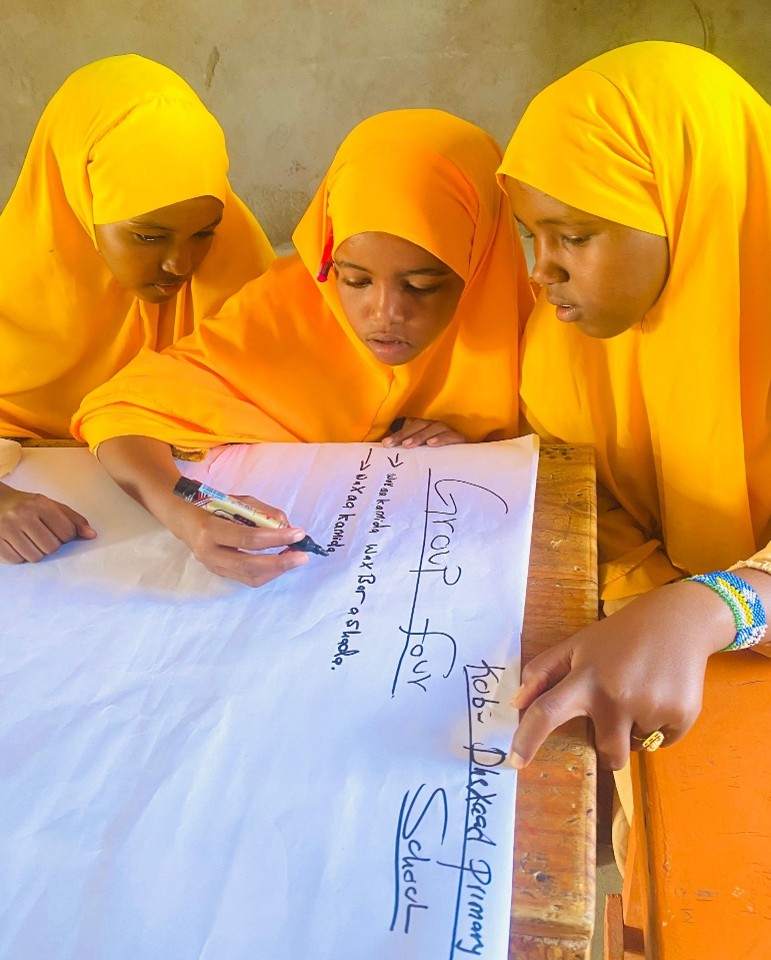
Between August and October 2025, the joint efforts of PMWDO and Save the Children International (SCI) marked a powerful shift in the fight against Female Genital Mutilation (FGM) and Child, Early and Forced Marriage (CEFM) across Puntland. Through community-driven interventions, youth empowerment, and targeted capacity-building, the project ignited meaningful behaviour change in 19 locations, demonstrating that sustainable transformation begins when communities lead the movement.
Empowering Girls, Boys, and Their Communities
The project’s first major breakthrough came through the rollout of the CHOICES model, an evidence-based approach that empowers adolescents to challenge harmful gender norms.
- 15 staff and partners trained on CHOICES—equipped to cascade knowledge to communities.
- 19 locations sensitized, reaching teachers, CECs, parents, and local authorities, and formally introducing PMWDO’s leadership in the project.
- 16 school-based clubs established, engaging 220 children in structured activities that promote child rights, gender equality, and anti-FGM/CEFM advocacy.
- 17 newly formed and strengthened children’s clubs received training, reaching 220 children (110 boys and 110 girls) and 17 teachers.
- 500 adolescents enrolled in 10-week CHOICES training cycles, guided by 40 trained facilitators.
These activities sparked a visible enthusiasm among young people. Many boys publicly expressed for the first time that FGM harms girls, while girls reported feeling “more confident to speak about their rights at home and at school.” Teachers highlighted the transformation in how children engaged with difficult topics—openly, respectfully, and informed.
Building Economic and Social Power for Women
Economic empowerment is a cornerstone of prevention. When women have income, skills, and confidence, they are more able to resist harmful traditional practices.
Across Qardho and Bosaso:
- 16 community sensitizations on Village Savings and Loans Associations (VSLAs) were conducted.
- 350 women trained using the EA$E model, equipping them with group financial management skills, leadership tools, and social empowerment.
- PMWDO distributed full VSLA kits—cashboxes, record-keeping tools, stamps, and notebooks—to all 16 newly established groups.
Women reported feeling, for the first time, part of a collective movement where they can support each other financially and socially. Several groups have already begun saving, demonstrating early signs of ownership and sustainability.
Real change happens when the whole community commits to protecting its girls. PMWDO successfully mapped and strengthened community structures in 19 villages, engaging 211 members, including elders, youth, religious leaders, ex-circumcisers, and influential community actors.
Through community conversations:
- 11 locations (5 in Bosaso, 6 in Qardho) initiated structured dialogues.
- Five community facilitators per location were trained and supported to mobilize 100 people per site, directly challenging harmful norms and developing local action plans.
This shift in dialogue—moving from silence to collective responsibility—is one of the project’s strongest markers of progress. Elders who previously viewed FGM as tradition began questioning its necessity; religious leaders amplified messages of protection; and youth groups committed to advocating for girls’ safety.
Strengthening Health Systems for Survivors
Preventing harm goes hand in hand with strengthening response services. Despite heavy seasonal rains, 34 female health workers from all 19 locations completed a 3-day training in Qardho on:
- Survivor-centred approaches
- Mental Health and Psychosocial Support (MHPSS)
- Clinical considerations for FGM- and CEFM-related complications
Health workers expressed increased confidence in their ability to support survivors with dignity, confidentiality, and professionalism—an essential step for ensuring girls and women receive timely, compassionate care.
Overcoming Challenges with Innovation and Flexibility
The project faced real constraints, including limited time, difficult terrain, and some locations with pre-established clubs under other programs. Despite this:
- Targets were met or exceeded across almost all indicators.
- Schools were quickly mapped and alternative sites identified.
- Communities in hard-to-reach areas were engaged through carefully coordinated field missions.
This adaptability strengthened community trust and ensured that no vulnerable group was left behind.
A Foundation for Stronger Action Ahead
Planned activities for November and December include:
- Leadership training for women and girls
- Capacity building for men and boys
- Engagement with elders and religious leaders
- Support to safe houses and survivors
- Full rollout of CHOICES and school rights club sessions
- Continued community conversations and monitoring
These next steps will deepen transformation and build on the strong momentum already achieved.
Conclusion: A Community Rising Together
This project has shown that when communities are equipped with knowledge, empowered economically, and supported by strong systems, they can take bold steps toward eliminating harmful practices rooted in tradition.
In just three months, PMWDO and SCI—working hand in hand with community structures, schools, parents, adolescents, and health workers—laid the groundwork for a safer future for girls and boys across Puntland.
The shift is clear: communities are not only participating—they are leading the change.